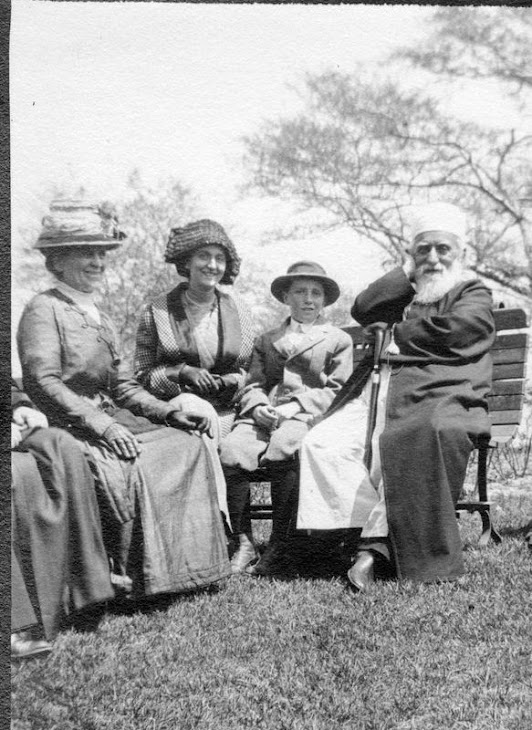
In 1912, Saichiro Fujita, one of the earliest Japanese Baha'is, met Abdu'l-Baha in Chicago, and accompanied Him through Denver and Salt Lake City, into California. In 1919 He relocated to the Holy Land, residing in the House of Abdu'l-Baha. He was befriended by Abdu'l-Baha and accompanied Him during many of His activities in the Holy Land. He was a source of joy to Abdu'l-Baha, and they joked together. As these photographs and Mr. Fujita's recollections demonstrate, he always showed proper respect to Abdu'l-Baha and to Shoghi Effendi. He served in the Holy Land for many years, at the invitation of Abdu'l-Baha and of Shoghi Effendi. Mr. Fujita was present in the Holy Land at the time of the Ascension of Abdu'l-Baha, and has left his recollections of that event, and of the reading of Abdu'l-Baha's Will and Testament. All of the photographs on this site are © Baha'i National Archives, Wilmette, used with permission.

Fujita in Abdu'l-Baha's car

Fujita riding Abdu'l-Baha's donkey, Lightning

L-R Mountfort Mills, Hand of the Cause of God John E. Esslemont, Saichiro Fujita in front of the House of Abdu'l-Baha

L-R The Master's gardener Isma'il-Aqa, The Hand of the Cause of God Amelia Collins, Saichiro Fujita; apparently in the Master's garden, Haifa

Fujita with Shoghi Effendi during the years immediately preceding the Ascension of Abdu'l-Baha.
In 1950 Shoghi Effendi's secretary wrote on his behalf to a Baha'i: "He feels you, and dear Fujita too, should devote particular attention to deepening the friends in the Covenant, which is the ark of safety for every believer."

Fujita accompanying Abdu'l-Baha on a visit to the Old Western Pilgrim House across the street from the Master's House

Abdul-Baha in front of His House with pilgrims, local Baha'is, and Indian soldiers, 1920.
More about this photograph is found here
More about this photograph is found here

Abdu'l-Baha with Saichiro Fujita visiting a Christian minister, Haifa, Israel. This building is directly behind the House of Abdu'l-Baha, and faces lower Hazionut Street. Mr. Fujita refers to this photograph in his interview with Sylvia Ioas: "I stayed with `Abdu'l-Baha two years. I used to go around everywhere. Always He ask me to go with Him. Even on Christmas Day, we have a little church here, behind the Master's house, we call on them. Have taken a picture too, with Master and minister and myself."
The following was written of Mr. Fujita in Japan Will Turn Ablaze:
Mr. Saichiro Fujita
1886-1976
1886-1976
Mr. Saichiro Fujita was the second Japanese to accept the Faith. Originally from Yanai, Yamaguchi Prefecture, Japan, he immigrated to the United States when he was a teenager. While he was attending school in Oakland, California in 1905 he was taught the Faith by Mrs. Kathryn Frankland.
He received two of the Tablets quoted below from 'Abdu'l-Bahá in 1906 and 1907. In 1911 he received a Tablet urging him to complete his professional training. In 1912 Mr. Fujita had the privilege of meeting the Master and traveling with Him in the United States. In this revised edition we have included one more Tablet by 'Abdu'l-Bahá, translated in 1913, because it contains a prediction about Mr. Fujita.
Between 1912 and 1919 there were several communications from 'Abdu'l-Bahá urging Mr. Fujita to study various aspects of engineering and also advising him to study flower culture. In 1919 he had completed his studies and left for Haifa as instructed by 'Abdu'l-Bahá. Mr. Fujita served in the Holy Land until the end of his life except for the years between 1938 and 1955 which were spent in Japan.
Tablets of 'Abdu'l-Bahá to Mr. Saichiro Fujita
O thou fresh plant in the garden of the Love of God!
What thou hast written was considered. It was an evidence of following in the Pathway of Guidance, and a proof of the attraction of the heart to the Beauty of His Majesty, God.
Consider what bounty God has manifested for thee, whence thou art and from whence are we. Yet, nevertheless, such a candle of love is burning in the hearts that its light is radiating from the East to the West and from the West extending to the East.
Rest assured thy name is registered in the Book of God, and it is hoped that thou mayest enter the Paradise of the Kingdom and find stability; to reach that which is the cause of the progress of the world of humanity in the world and in the Kingdom, and with perceiving eye, attentive ear, eloquent tongue and radiant face may serve in the Vineyard of God and spread the Divine Glad Tidings. If thou art confirmed as thou oughtest to be, thou wilt certainly establish an eternal Kingdom. This Kingdom is greater than that of Mikado, for the sovereignty of the Emperor of Japan is for numbered days, but this sovereignty is lasting and will stand unto the Eternity of Eternities.
That sovereignty can be hidden under one handful of dust, that is when Mikado goes beneath the handful of dust, he is entirely effaced and erased, but this Kingdom withstands the greatest revolution of the worlds, and will stand with perfect stability unto eternity. The former kingdom is established by the power of the sword, burning fire, devouring, and the shedding of blood, while this Kingdom is built upon freedom, glory, greatness and the love of God. Consider how much difference there is between them.
(Translated by Ameen Fareed, November 10, 1906, Chicago)
==================================
O thou spiritual Youth!
Japan has made wonderful progress in material civilization, but she will become perfect when she will also make spiritual developments and the Power of the Kingdom become manifest in her.
One will encounter a little difficulty in the beginning of the establishment of the Cause of God in that country, but later it will become very easy. For the inhabitants of Japan are intelligent, sagacious, and have the power of rapid assimilation. For the present a perfect youth like thee is favored by the Bounty of the Kingdom, and attained to the knowledge of the Lord of the Kingdom. Show thou forth an effort that thou mayest finish that which is necessary in the acquisition and study of science and art; then travel thou toward the countries of Japan; so that thou mayest hoist the Ensign of Truth, waving upon the Apex of the Supreme Concourse. Look thou not upon thine own capability, the Invisible Divine Confirmations are great, and the Protection and Providence of the Beauty of Abha is the helper and assistant. When a drop draws help from the ocean, it is an ocean itself, and a little seed through the outpouring of rain, the favor of the sun, and the soul-refreshing breeze will become a tree with the utmost freshness, full of leaves, blossoms and fruits. Therefore do not consider thy capacity and merit, but rely upon the infinite Bounty and trust to His Highness the Almighty. Do not delay. Undertake soon that which thou art intending.
There are prophecies concerning the Manifestation in the Buddhist books, but they are in symbols and metaphors, and some spiritual conditions are mentioned therein, but the leaders of religion do not understand. They think these prophecies are material things, yet those signs are foreshadowing spiritual occurrence.
(Revealed in 'Akká, May 29, 1907. Translated by Ahmad Esphahani,
July 21, 1907, Washington, D.C.)
==================================
O thou servant of God
Thy letter was received. It was an indication to the outward and inward health and safety. Therefore it became the means of joy.
As regard to thy profession of electricity. Endeavor from every direction that thou mayest gain perfect efficiency in it -- so that I may send for thee to come with electrical machine (automobile) and lighting plant -- in order that in the Holy Land thou mayest know how to run the electrical engines and dynamos, how to install electrical lights through the buildings and how to fill the batteries of the (automobile) and act (if necessary) as chauffeur. When thou shalt learn these things then I will send for thee. Thou wilt be confirmed to render a great service and this will become the cause of thine everlasting glory.
(Translated by Ahmad Sohrab, May 15, 1913, Paris)
==================================
After Mr. Fujita's passing the Universal House of Justice sent out the following cable:
Dearly-loved tireless steadfast Saichiro Fujita passed to Abha Kingdom after long years service sacred threshold. His rank in vanguard first Japanese believers. His labours World Center his dedication humility sincerity love will forever be remembered and provide shining example to rising generations Japanese Bahá'ís who will view with pride distinction conferred upon him. Praying Holy Shrines progress his radiant soul under loving grace his Master and Guardian both of whom he served so well.Universal House of Justice
(Cable received May 10, 1976)


 Posts


