THE STORY OF THE “GATE OF THE GARDEN” QUOTE FROM ABDU'L-BAHA
Inez Greeven told us in approximately 1980 that she went on Pilgrimage in 1920 during the days of Abdu'l-Baha and had many heavenly experiences. One example: One night, she was asleep in the same bed with her dear sister India, in the pilgrim house (I assume, the pilgrim house across the street and downhill from the Master's House, the Old Western Pilgrim House).
Inez Greeven told us in approximately 1980 that she went on Pilgrimage in 1920 during the days of Abdu'l-Baha and had many heavenly experiences. One example: One night, she was asleep in the same bed with her dear sister India, in the pilgrim house (I assume, the pilgrim house across the street and downhill from the Master's House, the Old Western Pilgrim House).

Historical photo of the Old Western Pilgrim House on Haparsim Street
Photograph taken approximately 1925, Copyright 2006
Baha'i International Community, Used with permission
In the middle of the night she awoke, and something was different. She couldn't put her finger on it. Then as she awoke more fully, she could see that she was floating several feet above the bed. She was startled, and got down, and began to walk around the room. She bumped into things and the noise awoke her sister. “What's wrong?” her dear sister asked. “I was floating in the air!” she said. “And I don't understand why...” and as she reflected on it, she knew for a certainty that at that very moment, Abdu'l-Baha was praying for her in the Shrines. Later that day she was walking in the streets of Haifa, and she saw the Master. He saw her, and walked over to her, smiled and asked, “Did you know I was praying for you?” She said yes, she did.
The Master also told her that she and her sister were permitted to come on Pilgrimage, because their mother was a good woman.
Near the beginning of her Pilgrimage, the Master asked her, “Where is your husband?” This was the one question she did not want Him to ask. She replied, “Well, he's not here, Abdu'l-Baha.” “Yes, I can see that he is not here. Where is your husband?” She replied that her husband had left her for another woman. “Yes, I know,” the Master said. “And because you have forgiven him, God has forgiven him.”
This would have referred to her husband at the time, presumably a Mr. Cook, because at the time of her first Pilgrimage her name was Inez Cook. Later, she married Max Greeven, an American Baha'i resident in Germany, greatly praised by the beloved Guardian. More about the two of them is found in "Dear Co-worker: Messages from Shoghi Effendi to the Benelux Countries," (Leuven: Brilliant Books, 2009) ISBN 9789057210006.
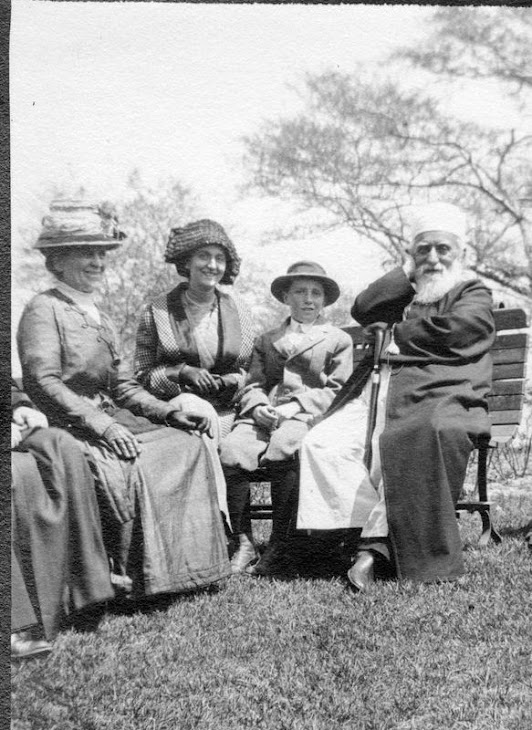
Here is Inez during her 1920 Pilgrimage. She is standing directly above Abdu'l-Baha's blessed head, holding the Greatest Name and a rose He gave to her.
On her return trip on the ship back across the Atlantic Ocean, she began to reflect on how she could convey her experiences to her friends. In particular, she wanted to share the grandeur of the Faith and of the Master, with two of her friends to whom she was teaching the Faith. She then thought of the idea of having them go to the Holy Land themselves. She thought that as soon as they met the Master, they would understand that this Faith is from God. She sent a cable to `Abdu'l-Baha and asked permission for her friends to go to the Holy Land and meet Him and visit the Holy Places, and He cabled back that permission was granted.
In those days it was quite an adventure to travel that far and visit the Holy Land. She made arrangements, and saw her friends off at the dock in New York as their ship sailed away. Some weeks later she came to the dock to welcome them home. She eagerly anticipated that they would tell her that they had become Baha'is. As they came down the walkway from the ship, she greeted them and gave them hugs, excitedly asking, "Well? Well?"
One of her friends said, "Oh, our trip was wonderful!"
"Well, tell me all about it!" Inez said.
"Well, first of all we visited the pyramids in Egypt."
"Yes, yes, go on," Inez said somewhat impatiently.
"And then we went to the Holy Land."
"Yes, yes!"
"And we went to Jerusalem and visited all the holy places."
"Yes, yes!"
"And then we went to Mount Carmel, and we met your Master."
"YES!"
"And he invited us into his home, and we had meals with him and his family. Why, they were the *nicest* people! And he told us funny stories. And they took us to beautiful gardens and shrines. It was wonderful."
Inez paused. "Is that all?"
"Is that all? What do you mean!? We had a wonderful time! Thank you for arranging it!"
So neither of her friends had become Baha'is, and she did not understand this.
Inez was apparently a wealthy woman, as she lived in a hotel in New York. The following year, in 1921, Inez returned to the Holy Land for a second Pilgrimage. This was not long before the end of the Master's life, as official immigration records show that she came back to the USA just a week before His passing.
During this second visit, she decided to ask him why her friends had not become Baha'is. She said words to this effect: "My friends came here, and they met you, and they visited the Holy Places, but they were unaffected. When I came here I was completely intoxicated with the greatness of the Cause. Why didn't they become Baha'is?"
`Abdu'l-Baha's answer was,
The Master also told her that she and her sister were permitted to come on Pilgrimage, because their mother was a good woman.
Near the beginning of her Pilgrimage, the Master asked her, “Where is your husband?” This was the one question she did not want Him to ask. She replied, “Well, he's not here, Abdu'l-Baha.” “Yes, I can see that he is not here. Where is your husband?” She replied that her husband had left her for another woman. “Yes, I know,” the Master said. “And because you have forgiven him, God has forgiven him.”
This would have referred to her husband at the time, presumably a Mr. Cook, because at the time of her first Pilgrimage her name was Inez Cook. Later, she married Max Greeven, an American Baha'i resident in Germany, greatly praised by the beloved Guardian. More about the two of them is found in "Dear Co-worker: Messages from Shoghi Effendi to the Benelux Countries," (Leuven: Brilliant Books, 2009) ISBN 9789057210006.
Here is Inez during her 1920 Pilgrimage. She is standing directly above Abdu'l-Baha's blessed head, holding the Greatest Name and a rose He gave to her.
On her return trip on the ship back across the Atlantic Ocean, she began to reflect on how she could convey her experiences to her friends. In particular, she wanted to share the grandeur of the Faith and of the Master, with two of her friends to whom she was teaching the Faith. She then thought of the idea of having them go to the Holy Land themselves. She thought that as soon as they met the Master, they would understand that this Faith is from God. She sent a cable to `Abdu'l-Baha and asked permission for her friends to go to the Holy Land and meet Him and visit the Holy Places, and He cabled back that permission was granted.
In those days it was quite an adventure to travel that far and visit the Holy Land. She made arrangements, and saw her friends off at the dock in New York as their ship sailed away. Some weeks later she came to the dock to welcome them home. She eagerly anticipated that they would tell her that they had become Baha'is. As they came down the walkway from the ship, she greeted them and gave them hugs, excitedly asking, "Well? Well?"
One of her friends said, "Oh, our trip was wonderful!"
"Well, tell me all about it!" Inez said.
"Well, first of all we visited the pyramids in Egypt."
"Yes, yes, go on," Inez said somewhat impatiently.
"And then we went to the Holy Land."
"Yes, yes!"
"And we went to Jerusalem and visited all the holy places."
"Yes, yes!"
"And then we went to Mount Carmel, and we met your Master."
"YES!"
"And he invited us into his home, and we had meals with him and his family. Why, they were the *nicest* people! And he told us funny stories. And they took us to beautiful gardens and shrines. It was wonderful."
Inez paused. "Is that all?"
"Is that all? What do you mean!? We had a wonderful time! Thank you for arranging it!"
So neither of her friends had become Baha'is, and she did not understand this.
Inez was apparently a wealthy woman, as she lived in a hotel in New York. The following year, in 1921, Inez returned to the Holy Land for a second Pilgrimage. This was not long before the end of the Master's life, as official immigration records show that she came back to the USA just a week before His passing.
During this second visit, she decided to ask him why her friends had not become Baha'is. She said words to this effect: "My friends came here, and they met you, and they visited the Holy Places, but they were unaffected. When I came here I was completely intoxicated with the greatness of the Cause. Why didn't they become Baha'is?"
`Abdu'l-Baha's answer was,
“At the gate of the garden,
some stand and look within, but do not care to enter.
Others step inside, behold its beauty, but do not penetrate far.
Still others encircle this garden, inhaling the fragrance of the flowers;
and having enjoyed its full beauty, pass out again by the same gate.
But there are always some who enter,
and becoming intoxicated with the splendor of what they behold,
remain for life to tend the garden."
some stand and look within, but do not care to enter.
Others step inside, behold its beauty, but do not penetrate far.
Still others encircle this garden, inhaling the fragrance of the flowers;
and having enjoyed its full beauty, pass out again by the same gate.
But there are always some who enter,
and becoming intoxicated with the splendor of what they behold,
remain for life to tend the garden."
The translator wrote this down for Inez, whose name at that time was Inez Cook.
On the long ocean voyage home, Inez thought about this, and thought about her two friends. She decided that what she would do, was to tell her friends everything. So after her return to New York, she met with her friends, and told them exactly what had happened. She then gave both of them a copy of `Abdu'l-Baha's beautiful statement about the gate of the garden, which is on the same theme as Jesus' parable of the sower and the seed.
One of these two women was attracted to the Cause, and became a Baha'i. Her name was Frances Esty. She became a lifelong devoted Baha'i. She compiled a lovely book of the Writings of `Abdu'l-Baha which she titled The Garden of the Heart. In the front of this book, which is extremely rare, she quotes this pilgrim's note, and thanks Inez Cook for it. It is often wondered where in the Writings this beautiful passage came from, and to whom it was revealed. It is not from the Master's Writings, it is a pilgrim's note from Him to Inez Greeven, and the earliest reference to it I know of is this early book, published by the Roycroft Press in 1930 in East Aurora, New York.
When Frances Esty died, I heard that she left her estate to the Baha'i Faith, and her community purchased a Baha'i center with the proceeds.
Brent


 Posts
Posts

